Posts

07 - Updates on the project (May 2020): Training weeks, TRA Visions, COVID-19, and first journal article!

Hello guys, I wanted to update you on my progress as the past months have been crazy! Firstly, I attended two SMARTI training weeks in the past months. The training on Automated Transport Infrastructures in Granada (Spain) in October 2019 and the training on Resilient Transport Infrastructures in Melbourne (Australia) in February 2020 . Of course, both were amazing experiences! Summaries of both events are (or will be) available on SMARTI's website . Secondly, I prepared an entry for the TRA Visions 2020 Young Researcher Competition . This EU funded competition provides an opportunity for BSc, MSc, and PhD candidates from all over Europe to compete for a cash prize and more importantly to showcase their research at the Transport Research Arena , one of the biggest transport conference in Europe! To participate students have to prepare a report, presentation, and poster about their research idea.  The entries are then judged by a panel of experts. In November 2019 , I ...
06 - My secondment at the JRC Seville

Image
Hello guys, I think that it’s time to properly talk to you about my secondment (or research visit) at the European Commission’s Joint Research Centre (JRC) in Seville (Spain). This visit started in November 2018 and lasted seven months. It was an amazing experience both professionally and personally. To summarise this experience, I thought that I could answer four questions: What is the JRC? The Joint Research Centre (JRC) is the European Commission's science and knowledge service. The JRC aims to provide EU and national authorities with independent scientific evidence and support to help tackle big challenges facing society. To this end, the thousands of scientists working at the JRC create, manage and make sense of knowledge, and develop innovative tools for policymakers. The JRC’s headquarters are in Brussels (like most of the EU institutions) but the JRC also has research facilities in Geel (Belgium), Ispra (Italy), Karlsruhe (Germany), Petten (the Netherlands), and Seville (Sp...

05 - Updates on the project (Sept 2019): SMARTI Interview

Image
Hello guys, it's been a while! I've been very busy these past few months working on my project, learning to code in R, going on secondment or conferences, writing papers and the list goes on...In this post, I will give you some updates on my journey. This post is an adaptation from an interview that I gave on smarti.eu (http://www.smartietn.eu/2019/06/30/smarti-etn-fellows-where-are-we-now-part-2/). What is the main achievement until now in terms of research? During the first year of the project, I conducted a literature review on existing resilience assessment methods for road networks, which allowed me to explore the research challenges related to this topic. Then, I developed novel and robust resilience indicators tailored to road networks. This work resulted in a conference paper accepted for the 2019 International Conference on Smart Cities (Seoul) . Besides, I am currently developing a novel approach to investigate the sensitivity of network performance to differen...

04 - Say YES to learning about Business & Entrepreneurship as a PhD Student

Image
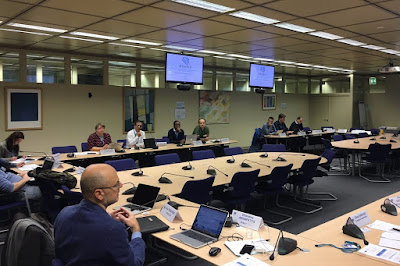
Hi all, I recently took part in a great competition developed to raise awareness of the commercialisation of ideas among PhD students and Postdoctoral researchers. In this post, I decided to share this experience with you because it could be very beneficial to you or your friends doing a PhD or Postdoc in the UK. This training is called YES for Young Entrepreneur Scheme (now you get the title of the article, right? ^^). To summarise the whole experience in one sentence: YES is a unique opportunity to experience the start-up creation process and see how an idea can be transformed into a business! But why would an engineering PhD student learn about business? Well, although PhD programmes are mainly designed to prepare for research and academic roles, not all PhD students want or can pursue a career in academia. Firstly, the academic world doesn’t suit everyone (due for example to the lack of application of the work done). Secondly, there are too many PhD students for too ...

03 - Quel pourrait être l'impact de la recherche sur la résilience des infrastructures ?

Image
En septembre dernier, j'ai donné une courte présentation sur mon projet de recherche ResilRoad à la Summer School 2018 de SMARTI à Palerme (Italie). À la suite de ma présentation, on m'a notamment posé la question suivante : quel pourrait être l’impact de votre projet de recherche ? J’ai pensé qu'il serait intéressant de partager la réponse à cette question dans l'article d'aujourd'hui. J'explorerai de manière plus générale l'apport possible de la recherche sur la résilience des infrastructures à la société. Premièrement, cette question est très pertinente car mon projet est plutôt théorique. L’objectif est de développer une méthodologie permettant d’évaluer la résilience des réseaux routiers, ce qui est plus difficile à appréhender que des sujets de recherche axés sur le développement de prototypes ou la réalisation d’essais en laboratoire. Mon projet repose sur l'idée que les réseaux routiers (comme tout système d'ingénierie) ont une pr...

03 - What could be the impact of the research on infrastructure resilience?

Image
  Last September, I gave a short presentation about my research project ResilRoad (Risk-based Resilience indicators for Roadway networks) at the SMARTI Summer School 2018 in Palermo (Italy). Following my presentation, one of the questions from the audience was: What could be the impact of your research project? I thought that it could be interesting to share the answer to this question in today's post. I will more generally explore the possible contribution of research on infrastructure resilience to society. Firstly, this question makes a lot of sense because my project is rather theoretical. The aim is to develop a methodology to asses road-network resilience, which is something that cannot be easily apprehended compared to research topics that focus on developing prototypes or performing laboratory tests. The idea behind my project is that road networks (like any other engineering systems) have a property called resilience, which represents their ability to sustain, ...

02 - Les portes ouvertes 2018 de l'Université de Nottingham

Image
Chers tous, Cela fait déjà 9 mois que le projet a commencé et alors que je faisais un bilan de ces derniers mois, j'ai réalisé que l'une des leçons les plus importantes et inattendues que j'ai apprises est qu'en recherche, la communication est presque aussi importante que la science. Une fois les travaux de recherche effectués, ceux-ci doivent être partagés et communiqués efficacement. Il y a de nombreuses façons de le faire : articles scientifiques (évidemment), présentations en conférences, affiches de recherche, mais aussi réseaux sociaux, vidéos... Allez sur ce lien pour voir ce que la Commission européenne pense de la communication scientifique. Cependant, au-delà des travaux de recherche, il est aussi important de partager notre passion pour la science, d'informer le public sur les derniers développements technologiques et d'essayer d'inspirer les prochaines générations (même si je ne suis pas si vieux ^^). C'est dans cette optique que j'ai p...

01 - ResilRoad (version française)

Image
Chers tous, L'article précédent était une introduction à ce blog. Il est maintenant temps de vous présenter mon projet de recherche ResilRoad. Comme il est mentionné dans le post précédent, je fais partie d'un programme de recherche, d'innovation et de formation appelé SMARTI. Mon établissement d'accueil pour SMARTI est l' Université de Nottingham (Royaume-Uni), où je suis ingénieur doctorant. L'Université de Nottingham - fondée en 1881 - est l'une des 20 meilleures universités du Royaume-Uni. Une des choses que j'adore à propos de cette université est son campus, qui est énorme, vert et a de superbes bâtiments (voyez par vous-même avec les figures 1 et 2).   Figure 1. Portland building (University of Nottingham) Figure 2. Yang Fujia building (University of Nottingham) Mon projet de recherche est le neuvième projet au sein de SMARTI. Par conséquent, vous pouvez aussi m'appeler ESR9 (Early-Stage Researcher 9) bien que Philippe soit plus simp...